

The adult animation series Strip Law premieres Friday, February 20th on Netflix and while I loved the ten-episode season, it is also a challenging series to explain. But I can tell you it is a comedy-dense, often insane series that relies more on humor and the strength of the characters than many shows in this genre.
Adam Scott voices the marginally-confident lawyer Lincoln Gumb, who has been fired from his late mother's law firm and is close to being forced to shut down his fledging Las Vegas law firm. Because this Las Vegas is one filled with over-the-top TV lawyers who feel more like used car salesmen than the next Perry Mason. But things begin to turn around for Lincoln when he teams up with street magician Sheila Flambe (Janelle James), who teaches him to loosen up and embrace the chaotic madness that is Las Vegas.
I recently had the opportunity to speak with series creator Cullen Crawford about how the show came together, his method for convincing Netflix to give him a substantial writer's room and the lessons learned from working on the series Star Trek: Lower Decks.
The interview has been lightly edited for clarity.
First, I wanted to ask you, what was that initial pitch meeting like when you went into Netflix? How did you describe the show? Because honestly, when people ask me about it, I've kind of given up trying to explain it and just say, "Look, it's funny, just go watch it."
Cullen Crawford: Honestly, that's kind of what my pitch was like. I just said, "I promise this will be funny." But we didn't know 100% what it was going to be when I pitched it.
I liked this idea of like a Vegas legal scene where billboard lawyers who dress up in wacky costumes and stuff are the big names. These are the people who run the legal scene in Vegas. So we started there. I made a bunch of fake billboards.
I actually paid a musician to record a fake jingle that's in the show. And I just had a bunch of jokes, basically. And I just said, "This is the kind of stuff you'll see in the show."
And they bit. And then as we worked on the show, if you told me when I sold the pilot that it was going to go to the places that we took it, I would have been as shocked as anyone.
Given that the show wasn't 100% in place when you pitched it, at what point in the process did you find yourself thinking, "Okay, that's what this show is. This is what it looks like."
It's interesting. I think probably it was episode three, because we pretty much wrote them in order. When we're talking about a lawyer means we can do this riff on The Mighty Ducks where a lawyer has to coach a youth hockey team.
And that led to all the crazy places it went. First of all, I get bored really easily. And second of all, I'll just go wherever I think the laughs are. And then we can take you kind of wherever we want. So yeah, I was running episode three. And I thought "This show is just going to go wherever, whatever is funniest."
One of the things I liked about the show is that I had the feeling sometimes you would set up an entire premise just so that you could deliver a specific punchline down the road. There's a scene in I think the last episode where you have these bunk bed desks for the two lawyers, which makes no sense. And then at one point you do a bro-hole joke and I thought, "Okay, that's why these desks are arranged that way because otherwise you can't do the joke."
Yeah. I think that was an offshoot of thinking what to do because we were doing a whole style parody in that episode of, "What would two kind of office would two playfully immature guys have?" So we did actually start with bunk desks there and then bro-hole grew out of that.
But absolutely, we will set up a whole episode just to take a left turn somewhere. And as far as that whole episode ten, we didn't know we were going to do that. Because I don't think I've ever seen a show do something along the lines of "What if the last episode of our show was a different show where our characters sort of accidentally invade this other show?" And that got me really excited.
So yeah, I'll just go anywhere for the laugh.
And without giving anything away, I have to say that that episode ended at a point where I found myself thinking, "Okay, it's going to be interesting to see where it goes from here because I have no idea what will happen next."
I actually have no idea. If you're talking about what I think you're talking about, which is the last scene of this show, I don't know what we're going to do with that yet either. I'm excited to see what we do.
One of the things I liked about this show is there's been a lot of talk in recent weeks about how Netflix wants everything really obvious. So if people are looking on the phone and they're watching this, they don't miss anything. And your show is just crammed with stuff that even if you're looking at the show, I found myself having to go back, and check "Did I just see what I thought I saw?" Did you get any sort of pushback or guidance from Netflix on that?
Absolutely, absolutely not. I was actually really dreading that note. I'd heard about that from other people and absolutely, our show is so dense that well, I mean, you could be doing the dishes and watching it, but it definitely rewards scrutiny in our show.
In my favorite shows, I will watch a hundred times and still find something new, you know, like 30 Rock and Community are two huge shows for me. And I've probably watched them probably 10 times. And to their credit, they've really let us do kind of whatever we wanted and the crazier we got, the more excited they got and the more dense we got, the more excited they got.
So it was the opposite of what I was expecting.
There is this moment in the first episode where a billboard goes by and I had to go back and look at it because it was something along the lines of promoting a magician who is the only one in Vegas who's not a virgin. And I wasn't sure that was what I had seen at first, it went by so quickly.
I love rewarding scrutiny. If anyone's willing to put in the work or give the attention to something, having something there for them, people who will pause on something and read all the signs. I wanted that to be a rewarding experience for anyone who's willing to give us that level of attention.
So I'm glad you noticed that. Thank you.
As you can tell, I really enjoyed the show and honestly, I guess for a better description, adult animation tends to be disappointing to me. Because it's usually, "Oh, this is animated and there's a lot of boob jokes and you know, ha ha ha. And this show is not that at all.
I appreciate you saying that. Because we really tried to make it feel and look a lot different from your average adult animated show. I think a lot of the jokes just come from places of either this absurd world we live in or these absurd characters.
And it's hard for me to put this into words, but it's just like you said, it's not all drug references. And I think even when we're being crass, the joke is almost about how we're being crass, not just that we're being crass. If you can appreciate the distinction there, that's like a big thing for me.
I've worked on some like aggressively crass stuff in the past and it always left me feeling a little gross. And I wanted to be a little bit simultaneously stupider and more high-minded if that makes any sense.
No, it does. You had mentioned shows that worked on before. And I wonder, as a writer, what you took away from shows. You came off working on Star Trek: Lower Decks, which got pretty good critical response, which I was happy to see. But when you're poking the Star Trek canon bear, sometimes people get a little annoyed.
I wonder if you took something from that experience of, "Hey, this is what I liked, or this is what I want to try the next time I get the opportunity."
First of all, working for Mike McMahan is the end. I learned a lot from that show, even though I don't think our shows are that similar. I learned first of all, yes, the Star Trek fandom is incredibly passionate, which is the double-edged sword, obviously. But the good side of that sword is what they are like when they love it. When they buy into something, they are full bore into it.
And similar to our show, Mike does a great job of hiding so many little Star Trek references because he knows people will be looking for it. There are so many little things if you're a Star Trek fan that pay off in that show. And so that was definitely a thing that imprinted on me.
And also just like Mike, that show taught me a real good sense of character. People will really invest in your characters if you teach them who these people are and what their foibles are. And as much as like I started out with all our characters being just joke delivery systems, I think they really did really grow a soul and each character has their own deal.
And that was definitely something I picked up on Star Trek.
When I was describing this show to my son, he asked, why is it called Strip Law? I said, well, you know, it has strippers in it. But it's also set in Vegas and there is this area they call "The Strip." And he thinks a second and says, "Oh, so the name means more than one thing?"
It's funny because that title came to me almost immediately when I was first thinking about a show. I didn't even have the characters at that point, but it was my first idea that I never even, I tried to beat it a couple of times and just decided, no, it just works. It doesn't actually mean anything. It sounds like like strip poker or something. You know what I mean? 
The name does has a very Nineties cable TV feel to it.
Yeah. So much in the DNA of this show is that I was a person raised by TV. There's a lot of TV tropes and plays on TV tropes and stuff. And it's just because I've truly been addicted to television since I was a child.
What did the writer's room look like? How many people did you have writing on the show?
We had, Oh boy. What is the number? I think we had eight writers.
This is my first writer's room. Putting it together and running it was maybe my favorite part of the job. Getting to call these people and offering them a spot. Because there was no one in the writer's room that I didn't previously know. These were all people I either had worked with or was a big fan of.
And some people were people I had been waiting to help. Emma Del Valle was probably our most inexperienced writer. She had never worked in a writer's room before and I had always wanted to give her a job. And she just knocked it out of the park. I was blown away by Emma and what she was able to bring to this room for the first time. But the whole room were killers. Everyone, I could not have been happier with this room.
I was scared of being in charge of them. They were all so great.
And that's a fairly big room for a TV show these days. Especially a streaming show.
Yeah. I was shocked. Uh, maybe the, I don't know if I should even tell this story, but maybe the coolest thing I ever did was I was having drinks with one of our executives and they asked, "What's it going to take to get you to start this writer's room?"
And over drinks, I said, "You guys probably want to do eight episodes and six writers. Give me ten episodes and eight writers and we'll go next week." And I felt like frigging Don Draper at that moment. And he just said, "You got it." That was maybe the coolest night of my life.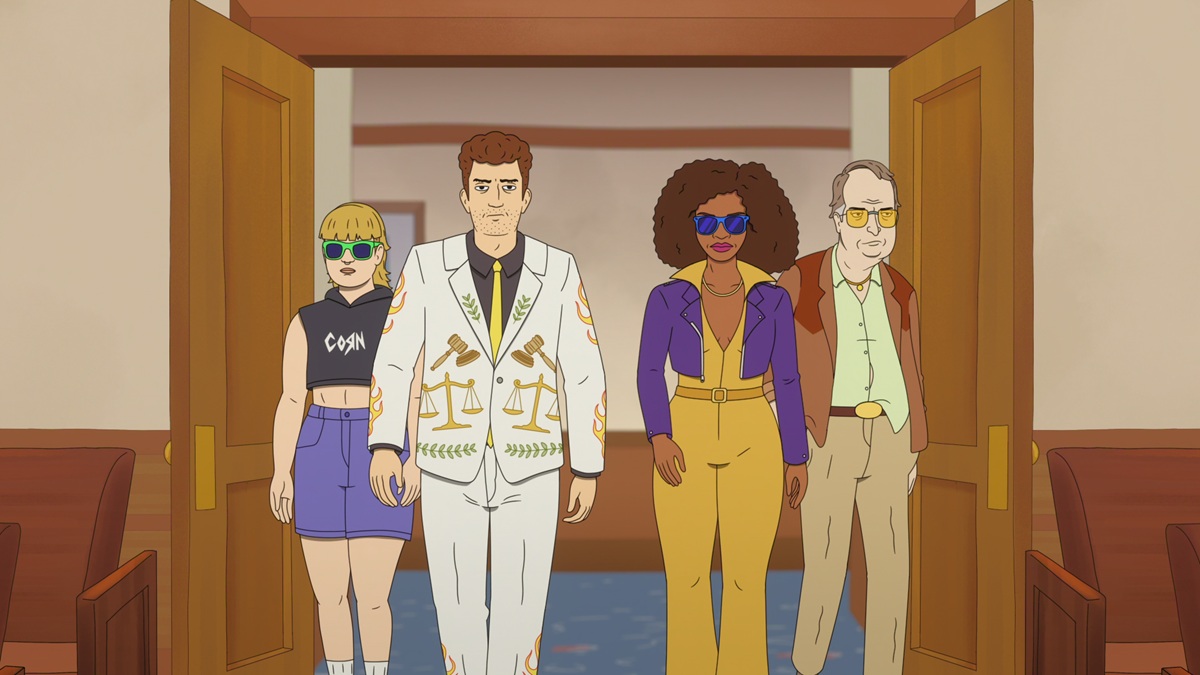
So what was the hardest thing of running this show yourself? You've obviously seen other people do it and you've talked to people, but when it gets right down to it, what was the toughest or most surprising thing about the process?
Running a room as a writer was definitely strange for me because I've always been kind of the weird guy pushing the show to go weirder or make a newer, a different choice or something. And it's hard to be that guy when you're in charge. You're sort of setting the premise for them to push against. And anytime someone challenged me, with "What about this crazy thing?" It made me so happy because it's hard for me to be that voice when I have to come in and be like, "Guys, today we're going to try this."
But then on a larger scale, every show I've ever worked on has just been as a writer. You spend your however many weeks in the writer's room and then you submit your scripts and then you come back a year and a half later and the show's made. Now I'm hiring line producers and taking budget meetings and giving feedback on art. And I can't even draw like a straight line.
Every part of the process was brand new for me. Which was both terrifying and thrilling. But it was so cool to get to learn how every aspect of how this is done and get to weigh in on everything.
Early on, I felt myself getting a little overwhelmed and I just decided that I'm not going to delegate this. I'm going to get in and savor this and get really granular with how this is made and try to understand things I don't understand. And it was really rewarding, even though it was difficult.
And I think you can feel in the end product. I hope at least you can feel in the end product that like there's a singular vision throughout every aspect of this show. Every choice is deliberate, not just defaulted to.
So as this process is playing out, did you have anyone you could call for advice or help, just because this process was so new to you?
Our supervising director, Adam Parton was incredible. I would definitely thank him and our line producer, Sean Gilroy and our art director, Tyler Rice. All of them really had my back through this whole process. They were just incredible resources.
Netflix has an animation guru onsite named Joel Trussell and anytime I was freaked out, he was just such a calming presence. Titmouse was also really cool to work with. Their senior leadership were always there for me if I had any problems.
Everyone told me to expect that early on, there's going to be some emergency, some problem somewhere along the way, some person's going to be bad. I kept waiting for it. And it just never happened. There were some small things, but there was never the disaster I was told was going to happen.
Everyone was so cool and talented and passionate. Everyone really put their whole ass into this show. 
I'm working on a book and I was told that the book publisher prints it and gets it into store. But selling and marketing the book was up to me. And it's pretty much the same thing in television, especially streaming television. A lot of it falls on you and that is sort of the way TV is these days.
Yeah, I was not exactly shocked, but definitely surprised about how much it does fall on you to do it. You know, after Twitter became a cesspool, I deleted it, even though I had a pretty good reach. And I'm really wishing I had right now, but obviously it wasn't worth it.
This is awesome. But I became a writer because I don't like to be the center of attention. I like to just do the work and show people that.
And now it's "All right, go on a hundred podcasts," with anxiety attacks in between them and stuff, because I just don't think of myself as the on-camera guy. I like to be away from all that stuff. Fun and cool at the same time.
The other side of that is that I'm certain you've been around people who don't have a problem with that. And usually they're jerks. So you, I think you're better off.
I think so. I'm trying to maintain my perspective on all this.
I got good at writing jokes and now all of a sudden, I'm in charge of a giant budget and doing all this stuff. Interviews with celebrities and directing the most famous people in the world. It's so crazy.
But it is truly fun. I feel like I won the lottery. I just want to do more of it, honestly.
You mentioned working with famous actors doing voiceovers. I've talked to other showrunners on animated show and they say that one of the weird things is that being a well-known actor isn't a guarantee they are going to be any good with voice work. Some of them are definitely better than others and you have to learn how to navigate that. And the flip side is they bring something so unexpected to the character that you end up changing it a bit. Because you realize, "Hey, this is not a direction I would have considered before this."
It was such a fun surprise because as a writer, almost to an annoying level, I know almost how every line in my head sounds. I'll say, "I want emphasis on this syllable. And then I want you to stop for 0.5 seconds. And sometimes actors would just bring that. Janelle James in particular, would just come in and nail every line on the first take exactly how I wanted it without me asking for it.
And then other actors like Stephen Root, especially, the character evolved around his approach to it. The character was not originally supposed to feel the way he feels now. Stephen just brought so many wonderful surprises to how he was portraying this guy.
And it was such a gift. And then Shannon Gisela, who plays Irene, we did a scratch audio with her playing Irene before we had a cast. And I was just so blown away by her that I just said immediately "That's Irene. We can't go with anyone else." There was some pressure to maybe get more of a name. And I just insisted, "No, she's too good. We have to have her."
I truly think she's going to be a superstar one day. The performance she turned in was incredible. I feel as if our voice cast deserves a writing credit because they helped flesh out these characters so much.
They made them real people in a way that enhanced the writing so much. I feel like I owe them so much for this. And it's funny because it's not a live action movie or show where you're on set for weeks or months together. These guys are coming in and spending a total of maybe 10 hours on the show.
It's just amazing. They're just killers. They just come in and do it.
And I've heard that a lot of regular actors aren't good in the booth, but everyone was so amazing. I was shocked by it.
And if they sucked, you weren't going to say it here.
No, obviously not, but I don't have to lie. That's even better.
I'll let you go with this question because I'm a little curious. One of your early credits was working on Late Night With Stephen Colbert. What was that experience like and do you think there's a place for a late night talk show anymore on broadcast television?
Man, I love late night television. I cut my comedy teeth on that. The reason I became a comedy writer was Conan O'Brien.
That stuff was so important to me. One of my first things I did live in Chicago was a live talk show. We just would do it at Second City at midnight and I met a bunch of comedy people, some of whom worked on Strip Law. Daniel Kibblesmith is one of them. And so I love late night. I feel like there is room for innovation.
Mulaney's recent run on Netflix showed some of the looseness and fun you can have with that world. And I think it's kind of a shame because I got my agent out of working for Colbert. I joined the Guild because of that job.
It was so exciting what we were doing. And then Donald Trump got elected. And just like that, it was "Now your job is to just chronicle this horrible man every day." And just that's what the appetite was. I do think it can survive, but it has to be in a much more niche way. I don't think the idea of a Carson can exist anymore, that everyone just tunes in to watch this one show. And it's sort of all things to all people. But the format is good. The format is capable of so much.
I just think you need something that's a little less constant and a little less controlled and a little more embracing the chaos of the format. I used to say all the time, the greatest Carson clip of all time is that actor throwing the axe into that guy's dick. You can't plan for that. You just got to roll with it. And that's what's fun about that format. I think podcasts are showing that people want this.
So I hope that it continues to exist. And I hope Steven does something really cool after the show wraps, because I think he's too talented to just go away after this.